Hot Water Replacement Repairs
Hot Water System Repairs vs Replacement: How To Know Which One You Actually Need
Table of contents:
- Start with the 50% Rule
- Step 1: Check the Age of Your Hot Water System
- Step 2: Compare Repair Cost and Recent Repair History
- Step 3: Calculate Your Hot Water Running Costs
- Step 4: “Replace It Now” Warning Signs
- Step 5: Rebates and Discounts That Can Change the Decision
- What to Ask Your Plumber Before You Decide
- Bringing It All Together: When to Repair vs Replace
- Frequently Asked Questions
When your hot water system stops doing its job, most people ask the same question.
Can we just fix it, or do we have to replace the whole thing?
Sometimes a simple repair is the smart move. Other times you are paying good money to keep an old system alive for one more year. This guide walks through a simple way to tell the difference.
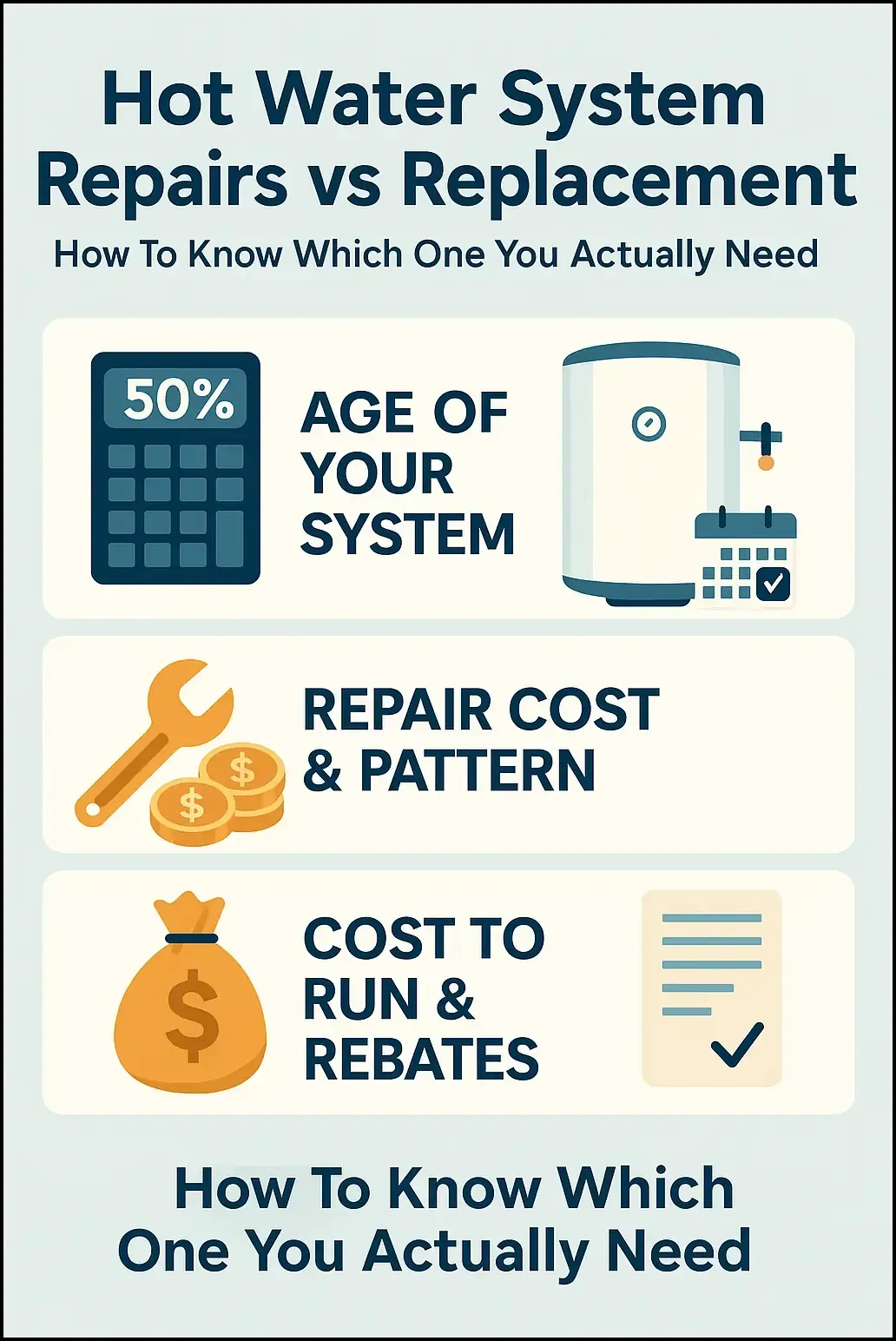
A good starting point is the 50% rule.
Does the repair cost more than half the price of a new system? Including installation and after any rebates? Replacement usually makes better financial sense.
If the repair is under half the price, repair can be the better option, as long as the system is not very old and is not breaking down again and again.
But do not stop at that rule. You also need to think about:
The age of your system
How often it has broken down recently.
How much it costs to run.
What rebates you can get on a new system?
All of these change the repair versus replacement decision.
Every type of hot water system has a typical lifespan.
Electric storage systems usually last about 8 to 12 years. Gas storage systems usually last about 8 to 10 years. Gas continuous flow systems usually last about 10 to 15 years, and sometimes reach 20 years with good maintenance. Heat pump systems usually last about 10 to 15 years. Solar systems usually last about 15 to 25 years, but different parts age at different speeds.
Water quality matters too. If you live in a hard water area, like parts of Queensland, South Australia, and Western Australia, your tank and anode can wear out 2 to 4 years sooner than usual.
A simple way to think about age is this:
If your system has passed roughly 75 percent of its expected life, big repairs usually do not make sense any more.
For example, a 10 year old electric storage system that starts leaking is usually a strong replacement case. On the other hand, a four year old heat pump with a simple thermostat problem is normally worth repairing.
Step 2: Look at repair cost and repair pattern
Next, look at both the size of the repair and the pattern over the last year.
On younger systems, one small repair is normal. Are your systems about eight years old? Things like a thermostat replacement, a pressure relief valve replacement, a pilot light service, or a single failed electric element are routine jobs. They are part of normal maintenance on a system that still has life left.
The warning sign is when repairs start to stack up.
If you’ve had two or more repairs in the last year that needed a licensed tradesperson, it often means the system is nearing the end of its life. This is true even if each repair seems minor on its own.
Big and expensive parts on older systems are another red flag. For example, if a heat exchanger on a gas continuous flow unit is over ten years old, replacing it is often a better choice due to the cost.
You should also look at your energy bills. If your bills are up by about 15 to 30 percent, and your hot water use has not changed, that often means the system is running less efficiently as it ages. In that case, even if you can repair it, it may not be the best financial choice.
Step 3: Check how much your hot water is costing you
Hot water uses about 25 percent of the energy in a typical Australian home, so this is not a small decision.
There is a clear gap between old and new systems. An ageing electric storage system can cost about 800 to 1,200 dollars a year to run on standard tariffs. A modern heat pump can do the same job for around $150 to $300 a year. It uses about 60% to 75% less electricity than a standard electric storage system.
That is a saving of roughly 500 to 1,000 dollars every year.
If an upgrade saves you about $600 a year and the new system costs $2,000 to $3,000 after rebates, you can expect to pay it off in three to five years. After that, the savings are pure gain.
So even if your old system can be fixed, it may still make more sense to replace it and save money every year on running costs.
Step 4: Know the clear “replace it now” warning signs
Some problems are clear replacement triggers.
Tank leaks are the biggest one. Once the inner tank has rusted through and is leaking, it cannot be economically repaired.
Rust coloured water from your hot taps is another strong warning sign. It usually means the inside of the tank is corroding, even if the outside still looks okay.
Heavy corrosion or rust on the outside of the tank, especially around the base, also points towards end of life.
For gas systems, persistent gas smells around the unit are a safety risk and need quick professional attention. In many cases, this leads to replacement rather than repair. Yellow flames instead of clear blue can also point to combustion problems and wider system trouble.
Finally, watch out for different parts failing one after another. A thermostat, then an element, then valves, all in a short time, is a classic end-of-life pattern. At that point, more repairs usually just delay replacement while costing you more in the long run.
Step 5: Remember that rebates can change everything
Government rebates can save you thousands on a new hot water system. This can change your choice between repairing and replacing it.
The federal Small scale Technology Certificates, or STCs, give a discount on eligible solar and heat pump systems. Depending on the system size and certificate value, you can save about $600 to $1,200 or more. Most installers apply this as an upfront discount.
On top of that, some states and territories offer their own help.
In Victoria, you can get federal and state incentives of about $2,500 to $3,500 or more. This applies when you replace an electric storage system with a heat pump. From March 2027, people replacing end of life gas hot water in Victoria will need to choose an electric alternative.
In New South Wales, the Energy Savings Scheme can provide typical savings of about 800 to 1,200 dollars when you include STCs.
In South Australia, the Retailer Energy Productivity Scheme offers eligible homes between $847 and $1,300 or more. Homes without gas connections can get extra help if they have concession cards. City of Adelaide residents can get an extra 1,000 dollar rebate.
In the ACT, the Home Energy Support Program can cover 50 percent of the cost of a solar or heat pump system, up to 2,500 dollars.
In the Northern Territory, Smart Energy Grants cover 50% of costs, up to $5,000. Plus, adding STCs can reduce the upfront price by 60% to 75%.
The federal STC scheme steps down each year and ends in 2030, so earlier upgrades often get you better support than waiting.
All of this means a replacement that first looks too expensive can become much more affordable once rebates are applied.
What to ask your plumber
When a licensed plumber comes out to look at your system, simple questions help you make a clear decision.
Research suggests you ask these questions:
What has failed and how do they know?
Do other parts look worn and likely to fail soon?
How much will it cost to repair versus replace?
Get itemized written quotes for clarity.
You can ask about the system's age compared to its normal lifespan. Also, check what rebates apply to your address. Finally, inquire about warranties for both repairs and a new system.
This lets you apply the 50% rule and the age and repair pattern rules with real numbers for your home.
Bringing it all together
It's usually best to repair when:
The system is still under its typical lifespan.
The repair cost is clearly less than 50% of a replacement after rebates.
You've had no more than one repair in the last year.
Isolated small faults like a thermostat, valve, pilot light or single element on a younger system fit this picture.
You should consider replacing your tank if:
It leaks or produces rust-coloured water.
You notice heavy corrosion.
There are ongoing safety concerns with the gas system.
You've had two or more repairs in the last year.
The unit is about 75% through its expected life.
A new, efficient system could lower your costs and rebates could reduce the upfront price.
By looking at age, repair history, running costs, and rebates, deciding between hot water repair and replacement gets easier. You’ll avoid another surprise cold shower.
FRequently asked questions
Is it better to repair or replace a hot water system?
It depends on the age of the system, the repair cost, and how often it has broken down. Newer systems with minor faults are often worth repairing. Older systems usually are not.
What is the 50% rule for hot water systems?
If the repair costs more than half the price of a new system after rebates, replacement usually makes better financial sense.
How long should a hot water system last in Australia?
Most electric and gas storage systems last 8 to 12 years. Heat pumps last around 10 to 15 years. Solar systems can last 15 to 25 years with good maintenance.
Is a leaking hot water system repairable?
If the inner tank is leaking, no. Tank leaks almost always mean the system needs replacing.
How do I know if my hot water system is becoming inefficient?
Rising energy bills, slower hot water recovery, fluctuating temperatures, or running out of hot water faster than before are common signs.
Is it worth replacing a working system to save on energy bills?
Often yes. Modern heat pump and solar systems can save hundreds of dollars a year, even if your old system is still working.
How many times should a hot water system be repaired before replacing it?
If you have needed two or more repairs in a year, it is usually a sign the system is near the end of its life.
Do rebates really make that much difference?
Yes. Government rebates can reduce the upfront cost by thousands of dollars, making replacement far more affordable than many people expect.
Can a plumber tell me whether repair or replacement is better?
A licensed plumber can assess the system’s age, condition, safety, and repair costs and help you compare this with replacement options.
What should I ask a plumber before deciding?
Ask what has failed, what may fail next, the full repair cost, replacement cost after rebates, and what warranties apply to each option.